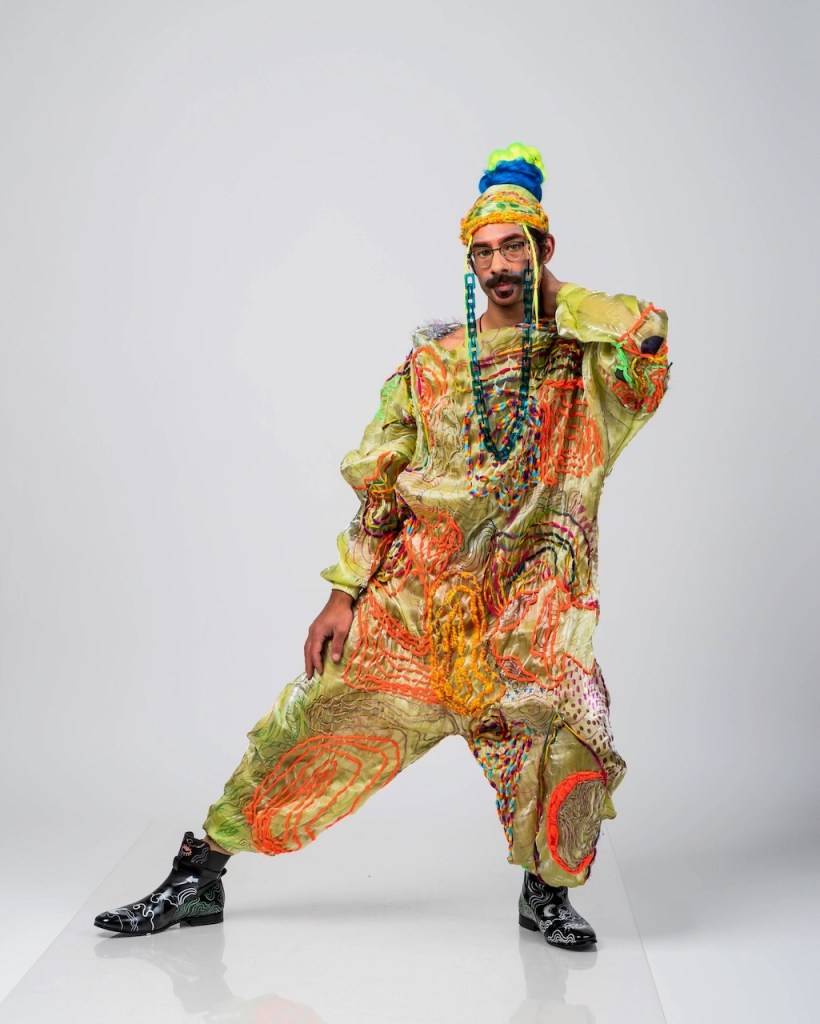
Robert Anthony Castillo Brea flows through many disciplines: musician, composer/arranger, electronic music producer, DJ, visual artist, and stone sculptor. He fervently refuses to be bound by a single medium. Born in Kansas City to a Mayan-speaking father from Mexico’s Yucatán Peninsula, and a mother from the Dominican Republic, Castillo is a first-generation US American who carries within him a confluence of cultures that informs the breadth of his work. His practice is driven by a restless desire to listen to the depths of existence, giving form to what emerges. At its core, Castillo’s art invites audiences to witness and awaken their own infinite creative potential.
After graduating from North Kansas City High School in 2010, Castillo received a major in Jazz Bass and minor in Environmental Studies from North Central College in Naperville, Illinois. By nineteen, he was performing professionally across the Chicagoland area, establishing himself within its vibrant music scene. His trajectory then shifted westward to Fossil, Oregon, where he accepted a position with AmeriCorps as the K–8 music teacher at Fossil Elementary School. It was in the vast stillness of the central Oregon high desert where Castillo discovered an abundance of time. There, he not only composed and arranged music, but also began to plant the seeds of visual art and deepened his meditation practice.
After his formative years in Fossil, Castillo relocated to Portland, Oregon, where he founded the groove-jazz ensemble The Sextet. The music written in the solitude of the high desert found its first full expression on the group’s debut album, In a Natural State. When Castillo returned to Kansas City in the fall of 2016, he reassembled the ensemble and continued its trajectory, releasing Blob Castle in 2017 and Among Friends in 2019, albums that chart his evolving compositional voice and his commitment to collaboration.
Among Friends stands as a tribute to musical diversity. Spanning two hours, the album traverses a remarkable span of genres including classical jazz, New Orleans–inspired second line, an Afrobeat reimagining of the jazz standard My Funny Valentine, a classical verbatim arrangement of Debussy’s Clair de Lune, and even a hip-hop track woven through shifting odd time signatures. The project’s audacity and range did not go unnoticed. Among Friends was warmly received, receiving recognition from National Public Radio.
Beyond his work with The Sextet, Castillo has built a wide-ranging performance career, collaborating with musicians across genres on stages throughout the United States and beyond. Among these projects was his tenure with The Standard vocal jazz ensemble, a group that secured seven DownBeat Music Awards during his time with them. His versatility continued to open new opportunities when in 2024 he joined the Latin rock band Making Movies as a substitute bassist for their European tour. In 2025 he expanded into theater, working as Sound Director for a production of Macbeth. There, he fused composition and electronic music production with live bass performance, crafting a sonic landscape that enveloped the audience in an immersive experience.
Castillo’s compositional reach extends past jazz ensembles, encompassing works for string orchestra, full concert band, solo piano, avant-garde trios, and everything in between. In 2022, 2024, and 2026, he composed and produced the music for theater productions in New York City. In 2025, Castillo was the sound designer for a wildly unique take of Macbeth, not only composing and producing the music, but also running the sound and performing live bass.
His relationship with music deepened further in 2023 when he began DJing, embracing a style as varied as it is fluid, moving effortlessly across electronic subgenres, anchored by the pulse of the dance floor. In his DJ performances, he amplifies this versatility by integrating his electric bass, weaving live instrumentation into his sets to match the dynamic energy of the audience.
In March of 2018, Castillo was presented with a challenge to produce enough visual art for a solo exhibition. Until then, painting had been shadowed by the discouragement of a poor grade in his seventh-grade art class that dissuaded him from pursuing the medium. True to his nature of embracing challenges, he accepted, and by December of that year mounted his first solo show. The exhibition was a resounding success in which he sold several works. This set in motion a steady rhythm of shows that has continued ever since. What began as an experiment unfolded into a passion deeper than he could have anticipated. Castillo refers to himself as a graduate of “YouTube University,” having relied on the platform to teach himself oil painting techniques that now underpin his evolving visual practice.
While much of Castillo’s visual practice is self-taught, in August 2023 he pursued formal study in Valencia, Spain, where he earned a master’s degree in Artistic Production from the Polytechnic University of Valencia. His thesis, “Shadows of the Empire: The Impact of the Spanish Invasions of Abya Yala on Indigenous Identity,” probes the enduring consequences of the sixteenth-century Spanish invasions on Indigenous identity. Anchored in his own Mayan and Taíno heritages, the paper reflects on how these historical ruptures have shaped his ability to connect with ancestral roots, while also proposing pathways toward reconciliation and renewed cultural dialogue. Five works anchor the dialogue of Castillo’s thesis, each addressing a distinct facet of colonial impact. A digital collage reflects on the invasions’ impact on land; a comic book–style image traces their effect on Mayan and Taíno languages; and a series of digital photographs explores disruptions to indigenous music. The spiritual dimension is evoked in an alabaster stone sculpture referencing the fractures in ancestral practice, while a letter to contemporary Spain, engraved with a dry-point needle, seeks to find a path toward reconciliation and healing.
Castillo’s visual art mirrors the eclecticism of his music, moving fluidly across styles and idioms. His subjects range from Post-Classic Mayan imagery, to refined geometric abstraction, realist portraiture, and plein-air impressionism. Equally as expansive are his materials. While oil painting remains central to his practice, he also works with gouache, watercolor, acrylic, colored pencil, spray paint, paint pens, glitter, and whatever else the moment demands. Each medium becomes a conduit for expressing the shifting contours of his inner landscape.
In January of 2022, on the cusp of his thirtieth birthday, Castillo turned his curiosity toward stone, beginning what would quickly become a vital new dimension of his artistic practice. Drawn by the material’s weight, permanence, and history, he embarked on stone sculpting with an immediacy that mirrored his fearless engagement with other disciplines. His first work in Carrara marble (only his second sculpture ever), was acquired in 2023 by the Nerman Museum of Contemporary Art. The acquisition not only affirmed his instinct to pursue the medium, but also situated him within a lineage of artists who approach stone as a living material capable of expressing contemporary questions of identity, form, and endurance.
In January of 2025, Castillo marked a new chapter in his career with his first European exhibition. Titled Danza de Color, the show was conceived as a cross-cultural dialogue between the Dominican Republic and Italy, supported by the Dominican Embassy in Rome. Staged in Ercolano (just outside Naples), the exhibition brought together the work of fourteen Dominican artists, each exploring the intersections of heritage, identity, and contemporary practice. For Castillo, Danza de Color evidenced his place within the international artistic community.
Castillo’s creative endeavors extend still further. In addition to his work as musician, visual artist, and sculptor, he also explores performance art and photography as vehicles for expression, each offering distinct forms of expression. His restless imagination is recently finding an outlet through writing. In the summer of 2023 he started writing a science fiction novel related to what he believes will be the long-term impacts of artificial intelligence. This literary project adds yet another dimension to his practice, reflecting his enduring interest in how creativity can probe into possible worlds.
In September of 2025, Castillo moved to Guatemala to serve as a PeaceCorps volunteer within the Youth in Development program. Guided by a deep sense of gratitude for the many blessings he has received, and by a spiritual path that had been increasingly calling him toward service, he embraced the opportunity to give back in a meaningful way. The role builds naturally upon his earlier experiences as a K–8 music teacher in Fossil, Oregon, and later as an art professor at Avila University, extending his commitment to education into a new cultural context. For Castillo, this chapter is an offering of the knowledge, creativity, and presence that has been gifted to him by the Divine.
Castillo’s path reveals an artist whose practice is marked by a desire to make an impact, displaying an ever-expanding search for connection and expression. Whether through sound, pigment, stone, movement, or the written word, his work insists on the permeability of boundaries and the vitality of cross-pollination. Rooted in his Mayan and Dominican heritages yet global in reach, his works embody personal emotional and spiritual excavation. His work reckons with history to embrace the present as well as the impending future. In this way, Castillo positions himself as a multidisciplinary conduit who channels the many faces of existence into creations that ask us to explore our own vastness.
 Robert Castillo