
“Abya Yala”
mixed media collage
21.5×40″ (55x102cm)
2024
$100
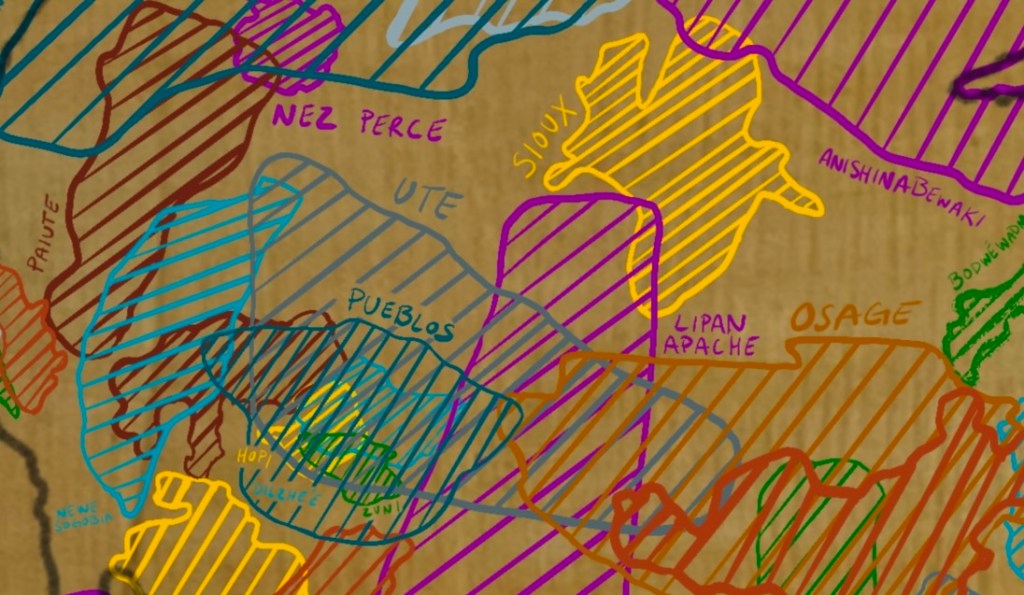
“Abya Yala” is a mixed-media digital collage designed to evoke the histories and experiences of the land long inhabited by Indigenous peoples prior to Spanish colonization. The work began with a piece of cardboard, painted over with acrylic paint to imitate the look of an aged map. A colored-pencil border, reminiscent of 16th-century cartographic styles, frames the background, referring directly to the period when Abya Yala was invaded. Layered atop the physical foundation are digital additions, highlighting the territories Indigenous groups once called home.
Because the collage covers an expansive geographic area, many of the labels indicating individual communities remain tiny and nearly illegible until greatly enlarged. This intentional choice underscores both the sheer number of groups that existed and the vastness of the land they occupied, prompting reflection on how much was lost over centuries of colonization.
The location of the Indigenous territories depicted draws on research by Native Land Digital, a nonprofit organization committed to conversations about colonial history and Indigenous–settler relations. Their maps are not static images. Rather, they depict both ancient and modern perspectives on Indigenous homelands. In many cases, communities were nomadic, moving across regions in patterns that defy a single fixed boundary. This raises challenging questions about how to accurately capture such fluidity in a static depiction. As Victor Sauca, Research Lead at Native Land Digital, explains, these maps represent a blend of historical and contemporary data. Some boundaries reflect migration over time, while others reveal forced displacements. This fluidity speaks to the deep complexity of land occupancy and the ongoing, evolving connections between Indigenous peoples and their territories.
A text within the collage reads (in Spanish, for its intended audience):
“Many indigenous peoples, languages, cultures, and religions once existed on this land. This map shows only a portion of the communities that once occupied the land of Abya Yala. Of those represented here, an even smaller portion survived the transgressions of Spain, Portugal, England, and other European invaders. What responsibility do modern Europeans have to heal the wounds left behind on this land?”
This inscription highlights both the magnitude of the destruction wrought by European empires and the enduring nature of its effects. By framing these transgressions as “wounds” that persist, “Abya Yala” underscores that these are not merely historical events, but ongoing realities affecting Indigenous communities today. It challenges viewers (particularly those of European descent) to consider their contemporary roles in addressing the legacies of colonialism. The piece further asks whether those who benefit economically from resources sourced in formerly colonized regions bear a responsibility to acknowledge and mitigate the lasting harm.
 Robert Castillo